
Tamil Nadu
The Lamp, The Hill, The Constitution: When the State Appeals Against Itself
(Rtd.) Justice V Parthiban
Jan 20, 2026, 01:55 PM | Updated 01:55 PM IST
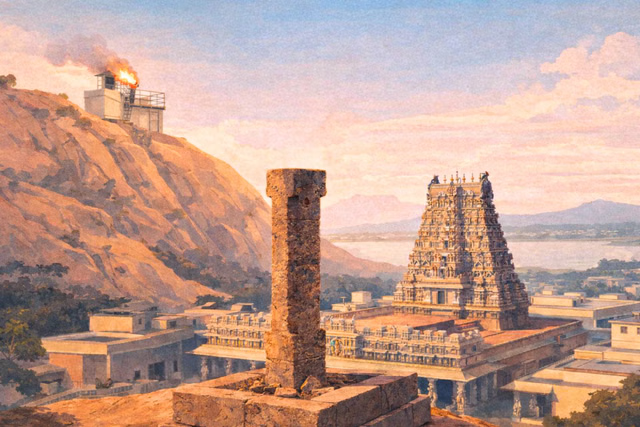
The Deepathoon verdict delivered on 6 January 2026 by the Division Bench of the Madurai Bench of the Madras High Court is not, at its core, about a lamp, a hill, or a single festival evening. It is about constitutional posture.
It concerns the role of the State in a plural democracy and the consequences of abandoning neutrality in favour of anxiety, optics, and institutional prestige. In affirming the order of the learned Single Judge through a judgment spanning nearly 170 pages, the Division Bench exposed not only the hollowness of the State's appeal but the deeper infirmity in its approach to governance itself.
The controversy arose from the order dated 1 December 2025 passed by Justice G.R. Swaminathan in W.P.(MD) No.32317 of 2025 and connected cases. The learned Judge directed the Executive Officer of Arulmigu Subramania Swamy Temple, Thiruparankundram, to light the Karthigai Deepam at the stone lamp pillar, the Deepathoon, situated on the hill, on the full moon evening of the Tamil month of Karthigai.
The direction was carefully framed. It was not the creation of a new ritual but the revival and restoration of an existing religious practice grounded in history and custom. The Court held that the Deepathoon formed part of the religious and property domain of the Devasthanam and that its customary observance could not be defeated by vague and elastic claims of apprehended law and order problems.
Objections based on Agama principles and speculative disturbance were rejected, the Court making it clear that apprehension without substance cannot extinguish a recognised religious practice. The mandamus was expressly protective and restorative, leaving questions of title and civil remedies untouched.
This order provoked a series of writ appeals by the State of Tamil Nadu, the District Collector, police authorities, the HR&CE Department, the Waqf Board, and representatives of the Dargah. On 6 January 2026, the Division Bench dismissed them all.
What sets this judgment apart is not merely the conclusion but the method. The Bench undertook a painstaking reconstruction of the history of the hill, the temple, the Dargah, and the litigation surrounding them for more than a century. Across 170 pages, the Court demonstrated that the appeals rested not on law or history but on apprehension elevated into argument.
The Bench was plainly troubled by the State's stance. It recorded that a matter capable of coexistence had been escalated by disgruntled elements and that attempts had been made to demoralise the judiciary through the exertion of power.
The appeals, in substance, were directed against rights of worship already recognised by the writ court. Reiterating the Single Judge, the Bench held that lighting the Deepam was nothing more than the restoration of a long-standing religious custom and an assertion of the Devasthanam's property rights.
The most stinging rebuke was reserved for the State's invocation of law and order. The Bench described the apprehension as imaginary and unconvincing, observing that any disturbance would arise only if sponsored by the State itself. Such language is rare in judicial discourse. It was not rhetorical excess but constitutional instruction.
Law and order, the Court reminded, is an obligation of the State, not a veto to defeat judicially recognised rights. To plead incapacity to maintain peace is not neutrality; it is abdication.
There is an irony here that borders on poetic justice. The Devasthanam concerned is not an autonomous body resisting State control. It is administered through executive officers under the HR&CE framework. The spectacle of the State appealing against a direction issued to an institution it itself controls, on the plea that compliance may cause unrest, reveals the incoherence of the State's position.
When a constitutional court directs a State-run Devasthanam to light a ceremonial lamp, the State is not being asked to take sides. It is being asked to obey constitutional discipline.
The verdict also reaffirms the true meaning of secularism under the Indian Constitution. Secularism is not executive timidity or strategic withdrawal from difficult decisions. It is principled neutrality governed by law.
Once a constitutional court has spoken after examining history, practice, and rights, the State's role is implementation, not resistance disguised as prudence. Appeals pursued to preserve prestige or avoid imagined backlash corrode the very neutrality the State claims to protect.
In the end, the Deepathoon verdict is a lesson in constitutional discipline. The judiciary has not merely resolved a religious dispute; it has corrected an attitude. The State must not invent fears, politicise historic practices, or abandon neutrality in the name of administration.
When the lamp is finally lit by the Devasthanam under judicial command, it will signify more than a ritual restored. It will mark a moment when constitutional authority prevailed over intransigence and when the rule of law reclaimed its quiet, luminous force.
Justice V Parthiban is a former Madras High Court judge.
 Join our