
Science
No Garden Of Eden: Human Evolution Was Never a Ladder, It Was Braided Like Ganga Through Shiva's Locks
Aravindan Neelakandan
Jan 18, 2026, 07:00 AM | Updated Jan 18, 2026, 12:35 AM IST
For close to two centuries, the story of human evolution was told as a tidy, upward climb. We have all seen the illustration: a hunched ape gradually straightening its back, shedding its fur, and growing a larger cranium until it finally stands tall as Homo sapiens.
It is the 'March of Progress', of course often culminating in a Caucasian white male. It is a linear narrative that also suggested we evolved in a single 'Garden of Eden'. That Eden was likely in East Africa. Then we spread out in waves, to conquer the world.
But that Eden of simple precursors—those primordial Adam and Eve archetypes of the fossil record—can no longer contain the torrent of data now surging from the earth. These recent discoveries do more than just complicate the map; they fundamentally interrogate the very axioms of our ancestral paradise.
Between late 2025 and early 2026, a series of landmark discoveries published in Nature Communications and Nature respectively have effectively shattered the old models.
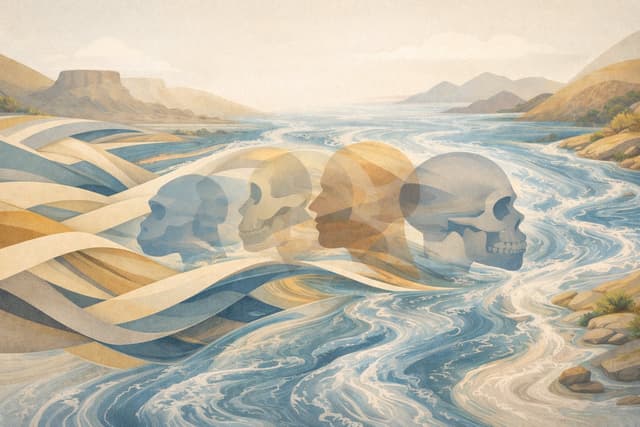
From the sun-scorched Afar region of Ethiopia to the coastal quarries of Casablanca, Morocco, new fossil evidence is forcing paleoanthropologists to trade their 'evolutionary ladders' for a chaotic and yet a more fluid braided stream.
Our origins, it turns out, were not a solo act. They were a continental mingling of overlapping species, mosaic bodies, and a persistent, ancient web of gene flow that makes our history as messy as it is infinitely more fascinating.
The Small-Brained Surprise of Gona
To understand how our origins became so braided, we must look to the Afar region of Ethiopia—the sun-bleached cradle of humanity where the earth literally cracks open to reveal the secrets. It was here that researchers recovered a shattered puzzle of a skull known as DAN5/P1. For years, these fragments remained a mystery, but through the wizardry of micro-computed tomographic scans and 3D surface modelling, scientists have finally performed a virtual 'resurrection' of this 1.5-million-year-old ancestor.
What emerged from such a digital resurrection was a scientific head-scratcher. Based on the timing, scientists expected to find a 'textbook' Homo erectus—the tall, clever ancestor often credited with being the first to possess a truly human-like brain and also considered the discoverer of starting and controlling fire.
Instead, the reconstruction revealed a complex evolutionary pioneer that refuses to be neatly categorised.
Whilst the cranium of DAN5/P1 looks like an erectus in its general shape, its size tells a different story. Its adult endocranial volume—the space inside the skull for the brain—is approximately 598 cubic centimetres (cc). At the very same time in history, other Homo erectus groups in nearby Kenya were already walking around with much larger cerebral volumes.
For comparison, a famous adult fossil from Kenya (KNM-ER 3733) possessed a brain volume of 878 cc—roughly 47 per cent larger than the Gona individual. Even the legendary 'Turkana Boy' (KNM-WT 15000), who died as a mere adolescent, already had a brain volume of 909 cc.
This creates a startling picture: rather than representing a biological contradiction or a 'failed' branch, DAN5/P1 exemplifies a mosaic of ancestral and derived features. It suggests that whilst some populations were pushing the boundaries of brain size, others were successfully surviving with a more archaic toolkit. It is the first hard evidence of a complex population structure in the early Pleistocene—a world where evolution was happening in piecemeal, regional bursts rather than one giant leap forward.
Even more confusing was the face.
Rather than the modern, projecting nose associated with the erectus lineage, DAN5/P1 possessed a flat midface and primitive teeth reminiscent of the much older Homo habilis.
This is not just the fabled 'missing link'; it is evidence that different populations of early humans were evolving at different speeds in different corners of Africa. Whilst one group in Kenya was developing the large brains we often associate with 'humanity', another group in Ethiopia was holding onto what are more archaic features whilst still successfully navigating their environment.
The Magnetic Flip in Morocco
Six thousand miles to the north-west, in Casablanca, Morocco, another discovery is filling in what scientists call the missing film of our evolution.
In January 2026, researchers published a definitive analysis of hominin remains from the Grotte à Hominidés at Thomas Quarry I, a site initially excavated between 2008 and 2011. The fossils—comprising a nearly complete adult mandible, a second adult hemimandible, a juvenile jaw, vertebrae, and a femur—have been precisely dated to 773,000 years ago (with a margin of error of just 4,000 years).
What makes these finds a scientific marvel is their precise temporal placement within a complex planetary transition: the Matuyama-Brunhes geomagnetic reversal. This was the Earth's last major magnetic pole flip, a process that unfolded over approximately 30,000 years (between 800,000 and 770,000 years ago). Far from an instantaneous switch, the reversal was a slow, asymmetrical decay of the Earth's magnetic field followed by a rapid recovery.
By analysing 180 magnetostratigraphic samples, researchers created a high-resolution 'magnetic fingerprint' of the site, capturing the specific moment this 11,000-year local phase of the reversal was etched into the Moroccan soil. Whilst the flip itself was a multi-millennial journey, the magnetic signal it left behind is globally synchronous. This provided a kind of cosmic timestamp, allowing researchers to lock these fossils into a worldwide geological calendar with unprecedented precision.
Like other Middle Pleistocene African fossils, the Thomas Quarry I jawbones show a mix of primitive and advanced features. The main jawbone (ThI-GH-10717) is surprisingly slender with a sloping chin area lacking the projecting 'point' of modern humans. In contrast, the larger partial jaw (ThI-GH-1) matches the robust size range of Homo erectus. Dated to around 773,000 years ago (give or take 4,000 years), these fossils represent an African population near the base of later human lineages, positioned close to the divergence from Eurasian Middle Pleistocene groups around this critical period.
There Is No 'Eden'?
For over a century, scientists studying human evolution have searched for 'the cradle of humankind'—a specific location where modern humans supposedly emerged from archaic ancestors before dispersing worldwide. This linear model, probably having deep archetypal roots in the Biblical myth of 'Garden of Eden', implied one population in one place developed key sapiens traits, then replaced others.
Behaviour and the Brain
The 1.6-million-year-old DAN5/P1 fossil from Gona, Ethiopia—with a small brain volume of 598 cc—has been found in direct association with both simple Oldowan choppers and more complex Acheulean hand axes. Oldowan tools involved basic cobble flaking for sharp edges, whilst Acheulean hand axes required symmetrical bifacial shaping through multi-step reduction—a significant technological advance.
This co-occurrence demonstrates that Acheulean technology was within reach of small-brained hominins. This decouples behavioural complexity from brain size expansion. This in turn highlights diverse evolutionary trajectories amongst Early Pleistocene populations.
The Gona DAN5/P1 discovery—that Acheulean tools co-occurred with a small-brained (598 cc) hominin—demonstrates behavioural sophistication without large brains, challenging neuro-centric models of technological capability.
Thomas Quarry I shows morphological mosaics near lineage divergence. Behavioural complexity emerged as a distributed capability across populations of varying neural architectures, preceding consistent encephalisation. ThI-GH mandibles exhibit primitive (receding symphysis) and derived traits, positioning them near Middle Pleistocene Homo lineage divergence.
Rewriting Human Evolution
Together, these discoveries reveal Early and Middle Pleistocene Africa's complex population structure—abandoning 'inferior-replaced-by-superior' models for interactive comingling through diverse bottlenecks. Multiple hominin groups adapted through technological innovation decoupled from brain size, cultural transmission via social networks, and gene flow reconnecting regional populations. Evolution was reticulate and multifactorial—a braided stream coursing through Africa's landscapes.
Like the Ganga weaving through Shiva's interconnected locks—each stream distinct yet converging in the greater flow—these ancient African populations developed sophisticated capabilities independently, then reunited through shared innovation.
Human evolution was never solitary neural ascent, but resilient braided streams nourishing our species across a continent.
Paper references:
Baab, K.L., Kaifu, Y., Freidline, S.E. et al. New reconstruction of DAN5 cranium (Gona, Ethiopia) supports complex emergence of Homo erectus. Nat Commun 16, 10878 (2025): Download here.
Hublin, J.J., Lefèvre, D., Perini, S. et al. Early hominins from Morocco basal to the Homo sapiens lineage. Nature (2026). Download here.
 Join our