
Science
Bridges Keep Collapsing Because Everyone Is An Incompetent Topper: Inside The Grade Inflation Crisis
Karan Kamble
Jan 19, 2026, 10:13 AM | Updated 10:59 AM IST
"You know how every other day bridges fall in India, right?" accomplished Indian academic and innovator Professor Amitabha Bandyopadhyay tells me over the phone.
Of course. No year's news cycle in the country seems complete without at least a few unfortunate instances of collapsing bridges and tragic loss of life.
"People think it is corruption," he adds. "Sure, there is corruption. But I will not rule out lack of competence. I think the real problem lies there."
In doing so, the IIT Kanpur professor reframes a familiar national failure whilst, interestingly, pointing to a quieter and more pervasive one, which extends well beyond India and into, perhaps especially, the elite institutions of the West: the declining quality of graduates.
Several senior academics I spoke to echoed this concern independently, even when they disagreed on causes or remedies. What worried them most was not isolated failure, but how consistently underprepared students now manage to move forward.
And not just bachelor's degree holders. This erosion of competence, they argue, runs through the entire education pipeline, from high school to higher education, all the way up to doctoral (PhD or Doctor of Philosophy) and postdoctoral research.
If that is the case, a contradiction emerges. How is it that students in recent years are not just passing in greater numbers, but also walking away with higher grades than ever before?
The Scale of the Problem
In Kerala, for example, a state that routinely posts pass percentages of 99 per cent in Class 10 examinations, S Shanavas, who was director of public education at the time, lamented in 2023 that even among students awarded the top A+ grade there were those who "do not know how to write their name correctly."
There is actually a term for this phenomenon. When students receive grades that far exceed their actual skills or performance, it is called grade inflation.
It is difficult to point to a single national dataset in India that conclusively captures its scale. Unlike some Western countries, India does not publish longitudinal data on student grade distributions across universities. Still, there are directional numbers and patterns that we can discern.
One of the few national systems that does track grades, albeit at the institutional rather than student level, is the National Assessment and Accreditation Council (NAAC). Over the past decade, a growing share of universities and colleges have clustered in the top A-range of NAAC's grading scale.
In several cases, institutions have recorded unusually large jumps in scores between accreditation cycles, prompting NAAC itself in 2023 to pause or review grades for dozens of colleges after puzzling improvements. Whatever the causes, the result mirrors what faculty describe inside classrooms: upward movement in scores that outpaces clearly demonstrable improvements in underlying capability.
Direct experience from within India's most selective institutions reinforces this picture and offers harder evidence. Professor Manindra Agrawal, director of IIT Kanpur, notes that when he was a student, roughly 25 per cent of his graduating class pursued PhDs abroad, primarily in the United States (US). Today, he estimates that percentage to have dropped below 5 per cent. Sure, the shift reflects changing career preferences; but it’s likely a fundamental reorientation away from the slow and deliberate pace of deep learning and research towards immediate employment.
How Standards Fell
"When I entered IIT Kanpur in December 2006, you had to score a CPI of 5 to get a BTech degree," says Prof Bandyopadhyay. CPI, or cumulative performance index, maps grades numerically: A is 10, B is 8, C is 6, and D is 4. "If you get a D grade in all the courses, you technically pass each course, but you cannot get a degree. Since you had to have a CPI of 5 over 40-50 courses, you had to have some As and Bs in the mix as well."
Today, that threshold no longer exists. "These days, at an IIT, you can get a D in all the courses and still graduate. Because now the graduating CPI is 4," he adds.
Even where the graduating CPI is higher than 4, the trend is still downwards. In late 2025, IIT Kharagpur, one of the country's oldest and most prestigious technical institutions, formally introduced a “BTech Pass” degree for students graduating with a cumulative grade point average (CGPA) between 5.0 and 5.9. Under earlier rules, students below a CGPA of 6.0 would not receive a degree at all.
The institute described the move as a way to help students progress in their careers and reduce the stigma of academic failure. But to critics, it marked something more consequential: the institutionalisation of lowered academic thresholds. What had once functioned as a clear signal, that a BTech from an IIT implied a minimum level of mastery, was now being recalibrated to ensure throughput rather than distinction.
The change does not imply that students have suddenly become less capable. Instead, faculty members say, it reflects how universities are increasingly reshaping credentials to absorb academic stress, parental expectations, and placement pressures, even if doing so quietly alters what those credentials are meant to certify.
Several factors may contribute to the grade downgrade, but the sociological aspect stands out. "Every time there is a suicide, everybody blames the IITs, that the academic pressure is high there. So then the only way the institutes know how to respond is by reducing the rigour," an IIT professor told me on the condition of anonymity.
This has an impact on faculty members as well. "Faculty members today are reluctant to award an F grade," the professor continues. "Because if a professor will give an F grade, and say later a student dies by suicide, everyone will conclude that the professor is a monster. So why will they bother? They will prefer to play it safe."
But the most consequential change, faculty members say, is what no longer happens at all.
Others describe the same dynamic in less blunt terms. Professor Agrawal says faculty caution has increased. "Earlier, when I was a student, getting an F grade was not at all uncommon. Nearly every course would have plenty of failed grades. That has changed. Now, the faculty generally tries to ensure that a student does not fail."
He adds that with class sizes exploding, from 220 students in his time to over 1,250 today, as per his estimate, failing large numbers can overwhelm instructors and administrations, making leniency appear to be the practical path of least resistance.
A Global Pattern
What makes this dynamic harder to dismiss is that it is not uniquely Indian.
Across universities in the US and Europe, faculty members are confronting similar questions about whether grades still perform their most basic function: signalling student achievement.
At Harvard College, an internal review published in October 2025 found that more than 60 per cent of undergraduate grades now fall in the A range, compared with roughly a quarter two decades earlier.
The situation became even more extreme during the pandemic: in the 2020-21 academic year, 79 per cent of all grades were in the A-range, according to data presented to the Faculty of Arts and Sciences. Though this has moderated somewhat, the median Harvard College GPA has remained an A since the 2016-17 academic year. Mean grades have climbed from 3.41 in 2002-03 to 3.80 in 2020-21.
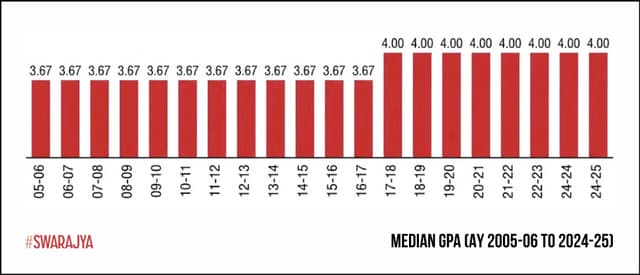
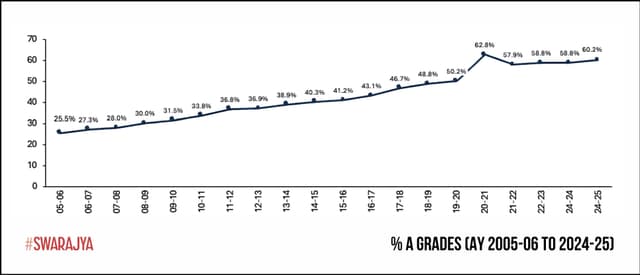
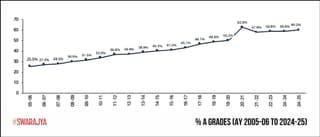
The report concluded that the "current grading system is damaging the academic culture" of the institution.
Grade distribution also varies significantly by field. At Harvard, according to a 2023 faculty presentation, 73 per cent of grades in Arts and Humanities fall in the A-range, compared with 65 per cent in Sciences and Social Sciences, and 60 per cent in Engineering courses, suggesting that grade inflation manifests differently across disciplines but pervades all of them.
The faculty involved in the review did not point to declining intelligence. Instead, they described mounting pressure on instructors to accommodate uneven student preparation and to avoid conflicts that could arise from lower grades — including poor teaching evaluations, student complaints, and administrative scrutiny.
Reporting by The Harvard Crimson suggests this experience is widely shared: a majority of faculty recognise grade inflation as a real problem and identify student evaluations, often tied to appointments, contract renewals, and promotion decisions, as a key driver.
The problem, however, extends far beyond Harvard.
A study by researchers Stuart Rojstaczer and Christopher Healy tracking grade trends found that between 1983 and 2020, average GPAs in American colleges rose from a little over 2.8 to 3.15, with private schools reaching 3.3, even as time spent studying dropped and literacy amongst college graduates declined.
At Emory University, according to an investigation by student newspaper The Emory Wheel, over 72 per cent of the Class of 2025 graduated with GPAs above 3.5, compared to only 41.5 per cent for the Class of 2005.
International surveys of university teachers echo this pattern. Many report frustration and a sense of powerlessness in the face of complaint-driven review processes and administrative incentives that reward smooth passage over difficult judgement. Some admit, candidly, to inflating grades simply to avoid procedural entanglements triggered by dissatisfied students.
In these settings, grade inflation is rarely explained as a collapse of ethics. It emerges instead as a predictable outcome of incentive structures: a consumer-oriented model of higher education in which students are treated as clients, satisfaction metrics influence institutional rankings, and faculty careers are shaped by feedback mechanisms that quietly penalise rigour.
At Emory, professors described the bind explicitly in interviews with The Emory Wheel. As one explained, "Student evaluations are a big part of how we are evaluated on a year-to-year basis. Our salaries depend in part on it. Our promotion depends in part on it, and so it's a difficult system. When faculty are put in a position of, 'If I give the grades that I think students actually have earned, if they're unhappy, it punishes me.'"
Another Emory professor noted how the high cost of elite education itself creates pressure: "The sacrifices that students and their families have to make to just get through a degree program at a school like Emory — it is hard to think, 'How much did I pay for this and what? How much did I sacrifice, and I am not being rewarded as I think I should be for future purposes, med school, law school, graduate school, jobs.'"
The long arc of this trend is visible even in individual academic lifetimes. Dr Vidyasagar recalls that when he graduated with a bachelor’s degree from the University of Wisconsin in 1965, “Senior High Honors” required a GPA of 3.75 out of 4. Out of 181 students in his class, only two met the threshold.
"The next highest GPA was 3.73, and that student did not receive high honours," he says. Today, by contrast, roughly a quarter of graduates at many public universities receive similar distinctions, with the proportion often higher at elite private institutions.
The change cannot plausibly be explained by a sudden, uniform increase in student ability. It reflects a steady recalibration of grading norms — one that has accumulated gradually enough to feel normal but isn't quite so.
India's Particular Pressures
India's experience, however, is sharpened by what happens before students even reach university and by powerful economic forces reshaping student priorities.
Professor Agrawal describes a transformation in student motivation driven by India's rapid economic development. "For these students, when they graduate, their starting salary is typically a lot more than their father's salary," he explains. "And now because of this huge gap, the entire family is so dazzled by the prospects of this very high salaried job that students can get; but it’s not just students, especially parents from day one are focused on ensuring that their child gets a very high paying job."
In such a scenario, learning can’t help but take a bit of a back seat in the best case. Students then optimise for placement outcomes rather than understanding. Rather than a moral failing, it’s more a rational response to dramatic economic opportunity, one that will likely persist, Professor Agrawal suggests, until India's development stabilises and the salary gap between generations narrows.
Distortions begin in the public examination system. Moderation policies and soaring pass percentages at the top end of board examinations have long blurred distinctions between strong and weak performance. Universities then inherit cohorts already trained to optimise for examinations rather than understanding.
The problem has deep roots. Despite comprehensive reform recommendations from the 2005 National Curriculum Framework and the 2016 T S R Subramanian Committee Report, which suggested changes to question paper formats, multiple modes of assessment, and even on-demand board exams, implementation has been minimal or non-existent.
One particularly pernicious aspect of India's system is the mandate that higher education institutions give equal weight to scores from all 33 examination boards, despite vast differences in rigour and evaluation standards.
As a 2019 EducationWorld investigation documented, this false equivalence forces even rigorous institutions to accept inflated marks at face value. When some state boards permit widespread malpractice or award marks liberally while others maintain stricter standards, the result is a race to the bottom.
Some students arrive at elite institutions for the wrong reasons entirely. As one IIT professor notes, students sometimes choose departments like biotechnology solely to gain admission to an IIT, only to discover they have no interest in the subject, creating a mismatch that breeds frustration and poor outcomes from the start.
The market has responded. Growth in international schools affiliated with Cambridge Assessment International Education and the International Baccalaureate tells a story of flight from domestic examination boards. According to data compiled by EducationWorld, Cambridge-affiliated schools in India grew from 145 in 2009 to 480 in 2019. IB schools increased from 27 in 2005 to 135 in 2019. Parents with means are voting with their feet, seeking certification systems they trust.
The same is now visible in professional examinations as well. In January 2026, the National Board of Examinations fixed the qualifying cutoff for NEET-PG, the gateway to postgraduate medical education, at -40 marks out of 800.
Officials defended the move as a pragmatic response to vacant seats and logistical constraints. But the decision triggered concern among doctors and medical educators, who warned that repeatedly lowering thresholds risks normalising minimal competence in fields where errors carry irreversible consequences.
Medicine, like engineering, depends not just on credentials but on mastery. When entry barriers are adjusted primarily to ensure throughput rather than readiness, the consequences may take years to surface, but when they do, they are borne by patients and the public.
Industry observers point to a related pattern. Multiple employer surveys over the past decade have converged on a similar finding: graduates considered immediately employable without extensive retraining are in the minority. Large firms now operate internal academies not to create excellence, but to compensate for the lack of even baseline skills.
A 2026 report by TeamLease Edtech, titled From 'Degree Factories to Employability Hubs,' found that nearly 75 per cent of India’s higher education institutions are not industry-ready, with curriculum alignment, practical training, and industry engagement surprisingly weak across the board.
Fewer than one in five institutions reported placement rates of 76–100 per cent within six months of graduation, and only around 9 per cent have integrated live industry projects into their programmes. Just 8.6 per cent say their curricula are fully aligned with industry needs, while a majority admit to little or no alignment at all, a structural disconnect that places additional weight on employers to remediate skill gaps that ought to have been addressed during formal study.
Economists describe this as a signalling failure. When credentials no longer reliably convey information about competence, every downstream institution, employers, graduate schools, even research labs, is forced to compensate. Foreign universities, too, have adjusted. British, Australian, and Canadian universities now employ rigorous additional screening for Indian applicants, whilst American universities require standardised tests like the SAT precisely because they cannot rely on board examination marks alone.
The Covid Inflection Point
Grade inflation had been building for decades, but then came the Covid-19 pandemic. It served as an accelerant.
At Emory, the average GPA reportedly increased by 0.2 points between 2020 and 2025, an increase 200 per cent greater than the cumulative rise from 2005 to 2019. At Harvard, the percentage of A-range grades spiked to 79 per cent during remote instruction in 2020-21 before moderating slightly but never returning to pre-pandemic levels.
Faculty describe being caught between impossible choices during the crisis. As one professor explained: "How can I possibly penalize any student for what may be a nonsuperlative achievement when the conditions are so difficult? That's basically why the grades went through the roof during the pandemic."
The crisis revealed something else: once standards are relaxed, restoring them becomes a tall order. What began as emergency accommodation has calcified into new norms for students who entered university during or after the pandemic, making any attempt to return to pre-2020 grading practices appear punitive rather than corrective.
Why Reform Has Failed
The troubling reality is that even when universities recognise grade inflation and attempt to address it, reforms typically fail.
Cornell University and Wellesley College offer cautionary tales of two different approaches, both unsuccessful. Cornell began posting median grades for courses on its registrar's website in 1998 and added them to student transcripts in 2008, hoping to provide context and encourage students to take challenging courses.
But rather than showcasing their abilities by taking difficult classes with lower grade medians, students avoided them to protect their GPAs. After sustained opposition arguing the practice disadvantaged them in the labour market, Cornell stopped posting median grades online in 2011 and, as reported by The Harvard Crimson, removed them from transcripts entirely in 2023.
Wellesley tried limiting mean grades in 100- and 200-level courses in certain departments to B+ starting in 2004. But a 2014 study by Wellesley economists found the policy expanded racial gaps in grades and reduced student enrollment in affected departments. Worse, faculty began exceeding the grade caps without facing penalties, and by 2019, with the policy having lost all teeth, Wellesley abandoned it.
Princeton University's attempt to limit A grades to 35 per cent was similarly repealed. Yale and Dartmouth commissioned committees that delivered recommendations, but according to faculty interviewed by The Harvard Crimson, implementation was left to individual discretion and little changed.
So what's happening is that grade inflation is easy to identify, difficult to address, and hard to reverse.
Student resistance, faculty non-compliance, unintended consequences, and administrative inertia conspire against even well-intentioned reforms. Every stakeholder in the system benefits from the status quo except, paradoxically, the students themselves, who receive inflated marks that mask deficiencies they will eventually confront in the workplace or advanced study.
The Consequences
The consequences extend far beyond the undergraduate classroom.
"When you see discussions online, people say graduates are not employable," says Prof Bandyopadhyay. "Why are they not employable? Because the learning outcome testing has been completely diluted."
He is unsparing about the result. "Hundreds of candidates I have interviewed, you would hesitate to employ many of them even for basic technical work. They are BTechs in computer science, in electronics, and this and that from reputable colleges, but they neither know anything about their subjects nor have general knowledge. They have never flipped the pages of the newspaper."
This leads him to say: "The country's future is at stake."
The problem manifests in stark, sometimes shocking ways. In the US, for example, education data reported by researcher Anand Sanwal revealed that 67 public schools in Illinois reported zero students demonstrating math proficiency, yet maintained graduation rates around 70 per cent. One "top school" spending $54,000 per student graduated 81 per cent of its students with zero demonstrated math proficiency. The disconnect between credentials awarded and capabilities developed could hardly be more complete.
In India, some graduates who struggle in industry return to universities, enrolling in master's and doctoral programmes despite fragile intellectual foundations. Faculty members across disciplines increasingly report that incoming PhD students lack even undergraduate-level mastery of core subjects.
"This year, the PhD students that I have admitted into my own lab, they don't even have BSc-level knowledge," says the professor who didn’t want to be identified. "This was not the case a decade ago. We were much, much better."
The PhD Problem
In theory, a PhD is not a continuation of coursework.
"PhD is a very special degree," says an experienced IIT professor who did not want to be named. "It is something you have to earn, you have to become deserving. Not everybody is supposed to do a PhD unless they are motivated to do it."
The reality is more complicated. PhD students today face pressures that extend well beyond intellectual challenge. They typically enter programmes between ages 21 and 26, a period when family expectations around marriage and financial stability intensify. In India's cultural context, these pressures can be particularly acute, creating stress that compounds the inherent difficulties of doctoral research.
These pressures are not unique to India. They are visible even in systems with far greater resources and research funding.
Recent US data illustrates this divergence clearly. According to the Council of Graduate Schools’ 2022 Graduate Enrollment and Degrees report, domestic first-time graduate enrolment declined by 4.7 per cent between Fall 2021 and Fall 2022, with the sharpest drops in engineering (16.1 per cent), public administration, business, and health sciences.
Overall PhD enrolment in the US has remained stable largely because of increased participation by international students, a trend analysts note is often influenced by exchange rates, visa regimes, and global economic conditions rather than rising enthusiasm for doctoral careers amongst domestic students.
In a 2016 analysis, the Economist noted that for many students, particularly outside a narrow band of elite institutions and disciplines, a PhD delivers weak financial returns and limited career flexibility. Outside academia, employers often value applied skills and experience over years spent in highly specialised research.
The result, the article argues, is a growing mismatch between doctoral training and labour market demand, a mismatch that discourages capable students from pursuing PhDs even as universities continue to expand doctoral enrolments.
Beyond motivation and personal circumstance, structural pressures shape outcomes. India now produces far more PhDs each year than there are permanent academic positions available, creating an inverted pyramid in which competition intensifies even as mentoring capacity and career prospects thin out.
“In any career, you will not blame a young student if he or she evaluates the possibility of earning a livelihood,” Prof Bandyopadhyay says. “If you do a PhD, what is the likelihood that you will get a stable academic job? In many experimental sciences, it is well below 10 per cent — and that secret is out.”
The calculus, however, varies sharply by discipline. In fields such as biology, chemistry, and the life sciences, doctoral training is often essential for research careers, even as permanent academic positions remain scarce.
In contrast, in engineering disciplines like computer science, electronics, or mechanical engineering, industry offers lucrative entry-level opportunities that pull top talent away long before doctoral study becomes attractive.
The result is a different kind of distortion. In some fields, PhD programmes struggle because career prospects are uncertain; in others, they struggle because the best candidates rationally choose industry over research. In both cases, the academic system is left with a narrower and often less prepared pool. And this is not because students lack ability, but because incentives point elsewhere.
The mathematics are stark. Prof Bandyopadhyay now supervises 10 PhD students in his lab, necessary because running a competitive research programme in biology requires Rs 1.5-2 crore annually, far more than any single grant provides. Multiple grants mean multiple deliverables, which require more hands. But a 1:10 supervisor-to-student ratio would require the creation of four times as many academic jobs every 5-6 years. That hasn't happened.
India's expenditure on science and technology has declined in real terms. Very few PhDs want to join and/or are absorbed in the Indian industries. Overall, a PhD is no longer a guarantee for a good stable career and thus the brightest are not choosing this career path.
Europe presents a partial counterpoint. According to data from the European University Association, the share of doctorate holders aged 25–64 across the European Higher Education Area rose by roughly 42 per cent between 2014 and 2022. This rise is often attributed to stronger integration between doctoral training, publicly funded research, and non-academic employment.
Other interviewees echo this structural critique, pointing to grant architectures and performance metrics that reward scale over mentorship. Professor V Ravindran of the Institute of Mathematical Sciences (IMSc) has warned that overemphasis on rankings and quantifiable outputs dulls research quality by encouraging quantity over depth.
"If you have this kind of metrics, rankings and things like that to evaluate you on a regular basis, obviously quality will go down," he says. (This subject is covered in depth in a different Swarajya article.)
The problem is compounded by differences in research infrastructure. Dr M Vidyasagar notes that in experimental sciences abroad, labs are large, hierarchical, and supported by robust postdoctoral systems, what he calls "CEO principal investigator" who may oversee 100 people across multiple tiers.
"In India, the postdoc culture is virtually absent," he says. Without that intermediate layer of experienced researchers between professors and PhD students, quality bottlenecks form quickly. "If the professor is not particularly good, the quality of the postdocs' work will also be mediocre."
Dr Vidyasagar offers a telling illustration from his own experience abroad. When he was head of bioengineering at the University of Texas at Dallas, he recalls reviewing an exceptionally strong faculty applicant who had completed a postdoctoral stint under a world-famous biologist, the kind who nominally "oversees" laboratories of more than a hundred researchers.
When Dr Vidyasagar contacted the supervisor for a reference, the response was effusive, describing in detail what “he” had accomplished. There was just one problem: the candidate was a woman. When Vidyasagar politely queried the discrepancy, he received a revised letter from the professor’s secretary, with the pronouns quietly changed.
The episode captures the limits of the CEO-style research model. At that scale, it's anyone's guess how closely senior investigators actually know the researchers whose careers they are meant to be shaping.
Faculty recruitment does little to correct this imbalance. Vacancies remain unfilled for years, hiring processes are opaque, and incentives to build strong research groups outside a handful of elite institutions are weak.
“Most successful Indian academics have done a PhD abroad or at least a postdoc abroad,” a senior scientist notes. “If they have worked only in India, they may not have exposure to the cutting edge.”
This pattern, however, is not simply the result of bias. Top research talent, regardless of nationality, tends to gravitate toward departments that are well-equipped, well-funded, and internationally visible. In India, such environments are few and far between. As a result, competitive hiring processes judged by uniform standards often favour candidates who trained in better-resourced laboratories abroad.
The outcome is a chicken-and-egg problem. Indian science remains less competitive in part because its best PhDs seek postdoctoral training overseas. When some of these well-trained researchers apply for faculty positions in India, they naturally perform better in open competitions than peers who remained within a weaker domestic postdoctoral ecosystem. This dynamic helps explain why postdoc culture within India’s universities remains thin or nearly absent.
Breaking the cycle would require sustained investment in university research infrastructure and the deliberate recruitment of top talent, measures that could gradually strengthen domestic training pathways. Yet universities often fail to create clear, transparent routes for high-quality PhDs to enter teaching and research roles, particularly in the broader university system beyond the top-tier institutions.
“Nepotism in appointments in universities is directly linked to this story,” the scientist adds, a subject examined in detail elsewhere by Swarajya.
If top PhD graduates from the best Indian research groups could more readily secure faculty positions in universities and colleges, it would create a natural career pathway whilst simultaneously improving undergraduate education, producing better-prepared students who might then pursue higher-quality doctoral work themselves. The cycle could be virtuous rather than vicious.
A Half-Century of Warnings Ignored
The problems identified today are not new discoveries. At Harvard, Professor Harvey Mansfield first raised concerns about grade inflation to then-President Derek Bok in 1975, noting that 85 per cent of students were graduating with honours. Nothing came of his warning, nor of similar observations by subsequent administrators over the following half-century.
"I occasionally provided reminders, for grade inflation and affirmative action were the two lost causes I espoused as an annoying Socratic gadfly," Mansfield wrote in a recent op-ed in The Harvard Crimson. "A dean once told me that if I shut up I would get the action I wanted. I tried that and it didn't work."
The persistence of the problem despite decades of recognition points to something deeper than mere administrative oversight. It suggests that grade inflation serves too many institutional interests to be easily dislodged, even when everyone involved privately acknowledges its corrosive effects.
What Remains
By the time students reach the top of the academic ladder, the system has already taught them its most important lesson: progress matters more than understanding.
So we see grades rising, degrees accumulating, papers multiplying. Movement is preserved even when mastery is not.
Bridges do not collapse because one engineer misunderstood a formula or simply chased money. They fail when systems repeatedly allow people to move forward without fully knowing what they are doing and reward the appearance of success over its substance.
The connection is not metaphorical. When graduates with inflated credentials but inadequate training enter fields like civil engineering, the consequences become literal. These are downstream effects of an educational system that has spent years prioritising throughput and credential over competence and capability.
Reform efforts elsewhere offer cautionary tales. Cornell, Wellesley, Princeton, Yale, and Dartmouth have all confronted grade inflation, and all have failed, in different ways, to reverse it. Student resistance, faculty non-compliance, unintended consequences, and administrative inertia conspire against even well-intentioned reforms once inflated grades become entrenched.
Yet the alternative, continuing to award credentials that mean progressively less, is untenable. As one analysis noted, when grades no longer signal competence, "grades don't mean anything." The entire edifice of educational certification loses its purpose.
"All of us, we are all guilty," Bandyopadhyay says. Not as an accusation, but as a diagnosis.
A system that inflates grades cannot later demand rigour. A system that treats doctoral students as labour cannot expect scholarship. And when those graduates go on to design bridges, literal or institutional, the consequences are often tragic.
Karan Kamble writes on science and technology. He occasionally wears the hat of a video anchor for Swarajya's online video programmes.
 Join our