
News Brief
Delhi Riots Case: Supreme Court Denies Bail To Umar Khalid, Sharjeel Imam, Grants Relief To Five Others
Swarajya Staff
Jan 05, 2026, 01:45 PM | Updated 01:45 PM IST
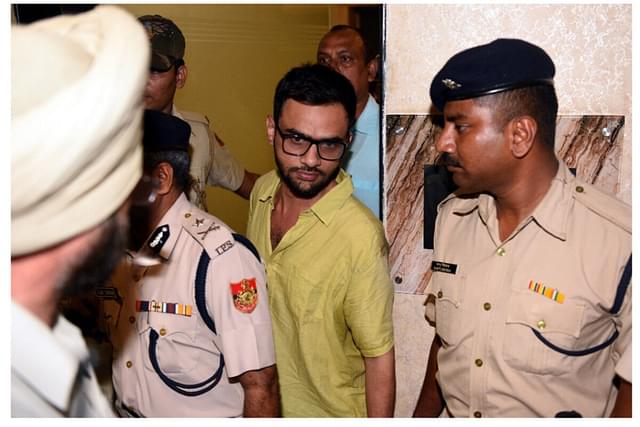
The Supreme Court on 5 January refused to grant bail to activists Umar Khalid and Sharjeel Imam in the Delhi riots “larger conspiracy” case, holding that the prosecution material discloses a prima facie case against them under the Unlawful Activities (Prevention) Act, 1967, Live Law reported.
At the same time, the court granted bail to five other accused — Gulfisha Fatima, Meera Haider, Shifa Ur Rehman, Mohd. Saleem Khan and Shadab Ahmed.
A Bench comprising Justice Aravind Kumar and Justice NV Anjaria observed that the materials on record indicate Khalid and Imam played a more significant role in the alleged conspiracy.
The court noted that the prosecution evidence prima facie pointed to “a central and formative role” and “involvement in the level of planning, mobilisation and strategic direction extending beyond episodic and localised acts.”
Recording its findings, the Bench said, “Threshold under Section 43D(5) stands attracted...continued detention has not crossed constitutional impermissibility to override the statutory embargo as against them.”
However, the court left the door open for future relief, allowing both Khalid and Imam to renew their bail pleas after the examination of protected witnesses or after one year.
In contrast, the court found that the remaining accused stood on a different footing. Emphasising that a collective approach would be inappropriate, the judges said the role of each accused must be assessed independently.
For those granted bail, the court imposed twelve stringent conditions, warning that any misuse of liberty would lead to cancellation.
Pronouncing the judgment, Justice Kumar clarified that in cases under the UAPA, trial delay cannot be treated as a “trump card” to automatically override statutory restrictions on bail.
At the same time, the court underlined that Section 43D(5) does not entirely bar judicial scrutiny, and courts must still examine whether a prima facie case exists against an individual accused. The inquiry, the Bench said, must be “accused-specific”.
The judgment also interpreted Section 15 of the UAPA broadly, holding that terrorist acts are not limited to overt violence alone, but may also include acts that disrupt essential services or threaten economic stability.
Khalid and Imam have been in custody for over five years following their arrest in connection with the February 2020 communal riots in Delhi.
Their bail pleas were earlier rejected by the Delhi High Court in September 2025. The Supreme Court has now directed the trial court to expedite proceedings.
Please click here to add Swarajya as your preferred and trusted news source on Google
Also Read: Supreme Court Puts Revised Aravalli Hills Definition On Hold Amid Environmental Concerns
 Join our