
Economy
From SEZ To ODOP: Is India Following China's Path To Development?
Rohit Shinde
Jan 19, 2026, 04:50 PM | Updated 04:50 PM IST
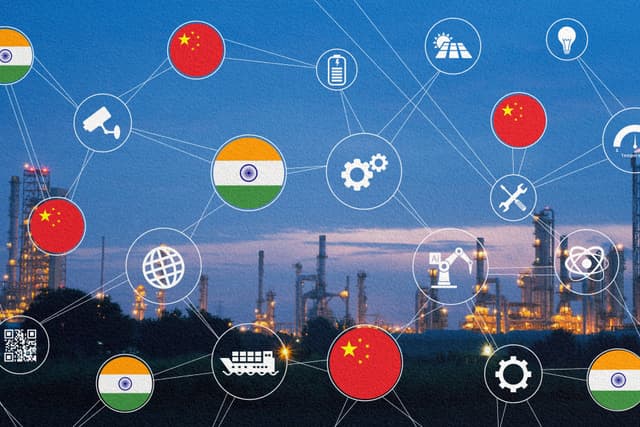
India and China have historically been the most populous states. Taken together, they accounted for almost half of global Gross Development Product (GDP) as recently as the 1600s. In the year 1600 AD, China and India comprised 29 per cent and 22.5 per cent of world GDP, respectively. But total GDP measures are not great measures to gauge the prosperity of a population. We need to look at GDP per capita. That is where India and China fall far behind.


Angus Maddison was a prominent British economist, interested in the scale of economic activity happening throughout history. He produced GDP per capita estimates going back to 1 AD. I've shown his estimated GDP per capita figures for the UK, China and India from 1659 to 2022. It is clear that by the year 1700, England had a GDP per capita 60 per cent more than China and more than twice that of India.
By the late 1940s, both India and China were impoverished, with low levels of GDP per capita. China further shot itself in the foot with The Cultural Revolution and The Great Leap Forward under Mao Zedong. Millions of people were killed under the guise of purging capitalist elements and collectivising the economy. India also chose to pursue the path of Fabian socialism, with its growth rate being lower than that of its neighbour and rival, Pakistan.
Mao Zedong dies and his successor Deng Xiaoping takes over in 1978. Coincidentally, that's the year when the destinies of China and India start to diverge. Deng Xiaoping abandons Maoist orthodoxy and initiates reforms to open up the economy. Special Economic Zones (SEZs) were established in 1980. China starts trading more with the world. It also started reforms in the agricultural sector with the "household-responsibility system". As a result, between 1978 and 1984, agriculture productivity grew by 5 per cent every year.
With increased agricultural productivity, labour began moving out of agriculture. That set up China for success in its manufacturing sectors. And now, China is on the cusp of being a developed nation. At present, India's GDP per capita is about $3,000 compared to China's $13,000. That's almost a fifth of China's.


To ensure there's no ambiguity throughout this discussion, I want to clear up what a developed nation means. The World Bank classifies all countries into four categories: low income, lower-middle income, upper-middle income and high income. The bar for being considered a high-income economy is that it must have a GDP per capita of $14,000.
Having a high GDP per capita comes with better human development, higher levels of human capital, lower child mortality, higher life expectancy and all other bells and whistles. In the words of Lant Pritchett: "Economic growth is enough, and only economic growth is enough". Essentially, all other measures of well-being for an economy are so strongly correlated with GDP, that just focussing on growing GDP is enough.
In other words, there are no poor countries with high levels of human development. The graph below shows just that.


I'll briefly explain why I think China, rather than East Asia, is a good comparison. All the East Asian tigers (South Korea, Singapore, Taiwan and Hong Kong) followed the same model to reach the ranks of developed nations. They focussed on land reforms, export-oriented industrialisation and capital allocation towards productive industries. There's a temptation to lump China in the same category.
I'd say that China is fundamentally different than most East Asian countries primarily because of its scale and its authoritarian political system. India is similarly different. India has hundreds of languages, multiple major religions, different ethnicities and a huge population to boot.
Because of these reasons, China is a good benchmark to compare India. Lessons from city-states like Singapore or Hong Kong are hard to generalise because of their small population or limited population diversity. Deep internal markets also provide a scale of their own and here China and the US are the only comparisons.


Infrastructure
China is known as the infrastructure monster and for good reason. It builds infrastructure at a breakneck pace. Even in things like road networks where India is comparable to China, the quality of roads leaves much to be desired. And that shows up in stats.
Notwithstanding that, India is quietly upgrading and building new infrastructure. The government continues expanding the network of national highways. Meanwhile, it is also building out its high-speed railway network, with the first line being operational by 2027. Infrastructure buildout is necessary for reducing the cost of logistics in the country. From a high of 13 per cent of GDP, logistics costs have come down to 8 per cent of GDP. With more infrastructure being built, I see this as something basic that all developed economies have to make the life of businesses and citizens easier.
Trade
The biggest lesson India seems to have learned is that trade is the fastest way to grow rich. China joined the World Trade Organisation (WTO) in 2001. Joining the WTO was the single biggest reason for turbocharging its growth. Foreign markets opened up access and China already had a strong manufacturing base. In the 20 years since joining the WTO, China's exports and GDP grew substantially.
Unfortunately, India had three structural reasons it couldn't take advantage of it:
It liberalised in the early 1990s. And even when it did, it didn't complete the entire set of reforms. Consequently, its manufacturing sector wasn't able to take advantage of its low labour costs and export labour-intensive goods.
The China shock to the US led to a loss of jobs in the politically sensitive manufacturing sector. As a result, suspicion of China started increasing among the US elite. This suspicion spilled over into globalisation.
The final blow to globalisation was the 2008 Great Financial Crisis (GFC). While globalisation didn't stop then, it laid out the road for Trump's election in 2016. And eventually, in his second term, he rang the death knell for globalisation.
Fortunately, India's deep domestic consumer markets could partially make up for the loss of external trade. But India's consumers are not yet rich to be able to afford fancy manufactured products. Individual Free Trade Agreements (FTAs) would go a long way towards increasing the amount of export-led growth.


India's share of world manufacturing exports is low. China has a staggering 14 per cent share of manufacturing exports. Even Vietnam has the same manufacturing share as India! With Production-linked Incentive (PLI) schemes, this seems set to change. India's electronics manufacturing is growing at a rapid pace.
India's Purchasing Managers Index (PMI) has been above the 55 mark for more than two years now. It only slowed to 55 in December 2025. The PMI surveys purchasing managers across various aspects of their business like hiring, growth and new orders. An index reading of above 50 indicates expansion. A reading above 55 strongly points towards sustained expansion of the manufacturing sector.


Private Sector and Protectionism
India's path towards closing itself to the private sector was a choice it made early in its independent history. Not only did it choose socialism, its experience of colonialism through the East India Company made it suspicious of the private sector. Unfortunately, that suspicion extended towards globalisation too. Public Sector Undertakings (PSUs) were deemed sufficient to provide growth. PSUs were tasked with growing heavy industry and manufacturing, but they weren't exposed to external competition.
Parts of China were colonised by Europe, the US and Japan. Yet, it didn't hesitate to open itself up during Deng Xiaoping's era in 1978. That gave it a headstart over India that opened up 13 years later. By that time, China had built up a decent enough manufacturing sector that when it acceded to the WTO in 2001, it could rapidly grow its exports to the world.


China's average tariff commitment to the WTO is 10 per cent. India has an average committed tariff rate of 50 per cent. Countries can only export more if they're able to import more. Higher tariffs also lead to a possibility of an inverted duty structure. Some goods required for intermediate production will have higher tariffs than the goods made using them. Instead of tariffs spurring local production, in such a situation, they will favour imports.
China also has committed a very low maximum rate for tariffs on imports. On the other hand, India has a 52 per cent rate that it's committed. This means that India can raise average tariffs up till 52 per cent without violating any WTO commitments. That shows the confidence that the Chinese have in their products and ecosystem. Hopefully, India follows down this same path.


Human Capital
One place where India is trying to catch up to China is human capital. Human capital is the amount of valuable skills and abilities that an individual possesses. It includes attributes like education, skill, training and management capabilities.
India focussed on tertiary education while China focussed on primary and secondary education. The Gross Enrolment Ratio (GER) for China's tertiary education crossed that of India in 2010. But China's GER for primary and secondary education crossed that of India in the 1990s.
Eventually, based on this stronger foundation, the GER for tertiary education increased for China too. It also managed to double the enrolment ratio for doctorates compared to India. Such strong underpinnings also helped China innovate more and reach the frontier in technologies like batteries, AI, solar and others.


India finally took note of the importance of primary and secondary education. The National Education Policy (NEP) 2020 aims to get the GER up to 100 per cent by 2030. An added benefit of the high GER for primary and secondary was that China had a huge glut of skilled labour that could be used by manufacturers.
Another area where India is starting to copy China is in the share of engineering grads. Through the 1960s onwards, China produced a large number of engineering grads. In contrast, India produced a relatively low amount of them. The trend line for that seems to be changing. I'm not sure if this is a conscious change, but regardless it is a welcome change. Recently, China's success vis-à-vis the US has been hypothesised to be because it is an engineering state whereas the US is a lawyer state. Going into the details of that hypothesis is beyond the scope of this post, but if there's any grain of truth to that, then India must increase the number of quality engineering grads it produces.


Brain Drain
Indians are usually the highest-earning ethnicities across the world. Indian-American households have the highest income across all ethnicities in the US. Before Idi Amin drove Indians out of Uganda, they were the highest-earning minorities there. Across the Anglosphere, Indians are usually in the top deciles of income.
Capable individuals are often motivated to migrate abroad. That's reflected in the career paths of students from the top institutions of the country. An analysis of IIT Bombay graduates from 1973-77 found that about 30 per cent of alumni had migrated abroad.


Quoting from Aravind and Devesh in A Sixth of Humanity:
In India's leading business school, the likelihood of those with better academic performance leaving the country was significantly higher. While the migration rate for doctors was about 3 per cent during the 1980s, it was 56 per cent for graduates of India's most prestigious medical training institution (the All India Institute of Medical Sciences or AIIMS) between 1956 and 1980, and 54 per cent between 1989 and 2000. Indeed, even a simple look at all eighty-six students who stood first in their Class 10 and 12 examinations conducted by the Central Board of Secondary Education and the Council for the Indian School Certificate Examinations between 1996 and 2015 found that more than half had moved abroad (primarily to the US) to study and work.
China similarly suffered brain drain until the mid-2000s. Undergrads would go abroad and settle there. Finally, in 2008, China enacted the Thousand Talents Programme (TTP). Financial incentives were given to top talent, should they choose to return. One-time bonus of more than $150,000 with research and startup funding reaching $1 million was provided. Most Chinese PhDs returned to China after the launch of the programme. The programme was quite successful.


Finally, India seems to be pursuing the same strategy. Without the brightest brains, it isn't impossible to build technological expertise at the frontier. The ANRF's Ramanujan Scholarship aims to build exactly that. It provides a financial stipend well above the norm, but far lower than what could be got in Western nations. Combined with the Visiting Advanced Joint Research Faculty (VAJRA), it aims to attract elite human capital to India at least episodically to lay down foundations for reaching state-of-the-art science.


Consumption
For China's level of development, the contribution of consumption to GDP is quite low. China does that by keeping its currency artificially low, thereby boosting exports. That comes at a cost of making imports expensive and so consumption was artificially suppressed. That comes with its own set of challenges.
Due to the peculiar structure of China's polity, real estate prices got bid up, ghost cities with skyscrapers were constructed and houses were the primary form of investment for consumers. With the property bust in China, consumption in the economy is even more repressed, thereby making it challenging to grow.


India's economic elite appear conflicted about currency devaluation, often treating the rupee's value as a matter of national prestige. If the goal is parity with the dollar, the simplest solution would be redenomination: declare that Rs 100 becomes Rs 1 and adjust all prices accordingly. A Rs 1,000 haircut would then cost Rs 10. This occurs without changing any real economic fundamentals. But this imposes high frictional costs on the economy without any commensurate benefits.
The RBI unofficially defended the rupee from 2022 to 2024. That's understandable if the goal is to gently glide the rupee down to its true level. For much of the past three years, the rupee appeared overvalued according to the Real Effective Exchange Rate (REER) measure. A REER above 100 indicates overvaluation which is bad for exports, while one below 100 indicates undervaluation.
For the past few months, the consensus seems to have been to allow the rupee to find its true level, thus boosting exports. I'll go one step further and say that the rupee needs to be further devalued. The Indian economy suffers from the Dutch Disease. Because India exports a lot of services, it earns foreign exchange that puts upward pressure on the rupee. That appreciation makes exports unattractive and dissuades manufacturing. If the rupee is allowed to depreciate further, services exports become even more attractive while goods exports are given some much-needed support.


Industrial Policy
The biggest pillar of China's development strategy is its Industrial Policy (IP). IP was widely considered to be the secret ingredient in the success of the East Asian Tigers. At China's scale, it has rolled out some truly staggering industrial policies. Taiwan developed by subsidising those export industries that proved that they could sell in the international market. Malaysia similarly rolled out many incentives and schemes for its electronic sectors.
India has had priority sector lending (PSL) for decades. Under PSL, banks were forced to lend to specific industries for a nebulous "financial inclusion". Some of these sectors were agriculture, housing and social infrastructure. On the other hand, China had something similar, but they used it for strategic sectors like Electric Vehicles, batteries and solar technologies.


India is trying to reduce cost of logistics as a share of GDP. To that end, it is undertaking various infrastructure projects. However, the crown jewel of India's IP is its PLI schemes. They're in strategic sectors like electronics, batteries, solar, automobiles and drones. The Electronics Manufacturing Services (EMS) has been a great success with an expected annual growth rate of 33 per cent for the next few years.


The biggest question is if IP is worth it? IP is a form of centralised planning and as we all know it tends to be inefficient. If an industry is worth growing, financial markets would help it grow. If inefficient regulations create roadblocks, it is prudent to remove those regulations. Unfortunately, there's no clear answers to these and only time will tell.


Foreign Investment and Infrastructure Diplomacy
As China grows, it needs more external markets to help it grow. It already has excessive manufacturing capacity. Developed countries are already wary of its impacts on their deindustrialisation. India is trying to close itself off to Chinese goods as well. So the Belt and Road Initiative (BRI) aims to build infrastructure and ports across various countries. The hope is that building infrastructure increases economic growth in these countries, opening up more markets for Chinese products.


Pakistan already has had problems with the China-Pakistan Economic Corridor (CPEC). The biggest problem is that these investments are expensive, and they must be able to generate the economic return required to pay off the loans taken to build them. I do not find anything problematic with that. Many developed countries help their companies find new markets for their products abroad. Not only does it help with increasing the revenue that these companies generate, it also increases geopolitical leverage.
India is starting to draw similar lessons. Consider this:
1. It is using its Exim bank to provide concessional loans tied to defence purchases from India companies. Countries like Armenia, Mauritius, Egypt, Kenya and Seychelles are purchasing Indian defence equipment.
2. Indian companies will likely set up manufacturing plants to increase their defence exports. Tata has already set up an armoured vehicle manufacturing plant in Morocco. It wouldn't be done without Tata expecting defence exports to increase at a good enough rate to recoup the cost of the plant.
3. Through the Exim bank itself and various export facilitation frameworks, India provides policy support to exporting companies.
4. The India Middle East Corridor (IMEC) and the International North-South Transport Corridor (INSTC) have the same logic as the CPEC initiative by China. These are strategic trade corridors intended to help its industries access favourable markets bypassing unfavourable geopolitical circumstances. India also helped develop Iran's Chabahar port, but that's unfortunately caught up in the current tariff wars due to Iran's counter-revolutionary movement.


One District, One Product
China copied the concept of One Village One Product (OVOP) from Japan. In Japan, it began in the Oita Prefecture where residents of a village would specialise in one product and gain revenue from selling and exporting that product. OVOP is a good way for rural areas to develop. Local governments actively support clustering, upgrading and market access for that product. With many such products across multiple villages and towns, it is highly likely that at least a few will become good enough for exports. Successful OVOP clusters upgrade into automation, branding and higher-end products or get into low-margin mass manufacturing. Both outcomes are acceptable. One provides high employment while the other provides export competitiveness.


India has implemented the One District, One Product (ODOP) scheme which aims to do the same. Synergies with existing schemes make it more powerful and make it likely for at least some products to succeed in export markets.
Other Similarities
There are other similarities between how India and China are developing:
1. Telangana has unveiled a Rs 1,000 crore fund for startups. China's subnational governments often have funds like the Shenzhen guidance fund and the Xinjiang Uyghur guidance fund.
2. China's air pollution peaked in 2014 and as it got richer it worked on improving its Air Quality Index (AQI). India's pollution story will likely follow a similar trajectory. Urban issues are starting to make their way into electoral politics and once that happens, solutions would hopefully follow.
3. In the late 1990s through the 2010s, multiple companies established offices in China. They focussed on manufacturing research, hardware and industrial design and applied research. That helped China reach the technological frontier. The current wave of Global Capability Centres (GCCs) establishing offices in India follows the same trend. Global expertise is transferred locally. Consequently, positive spillovers like knowledge transfers happen, helping Indians reach the technological frontier themselves.
As I have mentioned multiple times, India needs to grow at 8 per cent for 20 years to reach the ranks of developed countries with a GDP per capita of $14,000. It might be heartening to see that India is following China's steps, but it must be remembered that China is still a year or two away from reaching high-income status.
China's industrial policies are highly inefficient. They pay companies in the same domain to compete against each other, thereby competing away all profits. That's caused a lot of issues in China, including the current real estate bust.
It would be interesting to see what happens in the next decade:
Would China's GDP keep growing at more than 5 per cent? Even if it reaches high income, it is still quite a bit away from reaching the income level of the US and other Western countries.
How much of India's growth would be hampered by the deglobalisation of world trade? World trade offers an easy way to growth. There are more roadblocks on that path now. Can the current spate of FTAs with regional blocs continue? The data is encouraging on that front.
Ultimately, will India and China be able to reach the innovation frontier leapfrogging past the West? For more than 400 years, the West has held the lead in technology. As two of the world's ancient civilisations, it befits these countries to take the lead on innovation.
Note: The article was published on his substack: The Indic Prism.
Rohit Shinde is a software engineer based out of the US. He likes keeping up with the latest research in economics and applying it to problems in India. He posts on X from @rohitshinde121.
 Join our