
Commentary
INSV Kaundinya: A Live Floating Historical Argument
Prof. Vidhu Shekhar
Jan 13, 2026, 07:00 AM | Updated Jan 14, 2026, 12:39 PM IST
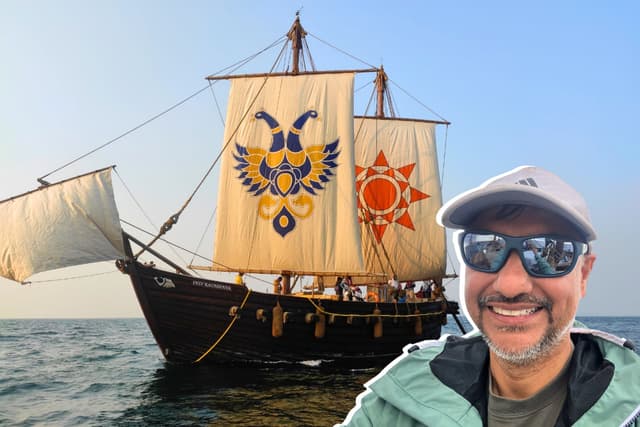
As Sanjeev Sanyal, Economic Adviser to the Prime Minister and member of the PM's Economic Advisory Council, boarded a wooden stitched ship sailing into the Arabian Sea, it was not for personal adventure or heritage theatre.
It was for something far more unusual in public life: making a live historical argument, subject to the same tests of endurance, material failure, and verification that govern engineering or science.
INSV Kaundinya is his evidence in motion.
An Economist Goes to Sea
For decades, Sanyal has questioned inherited historical narratives, including those framing India as a passive participant in global maritime systems. His work has argued that colonial historiography underplayed indigenous capabilities whilst exaggerating external agency.
But arguments on paper can be dismissed as interpretation. A ship at sea cannot.
The central claim behind INSV Kaundinya is deceptively simple: ancient India possessed the technological and institutional capability for sustained blue-water navigation. Not coastal hopping or accidental drift, but deliberate, repeatable, open-sea travel across the Indian Ocean.
Whilst specialist scholarship has long acknowledged Indian maritime activity (the work of K.N. Chaudhuri, Sanjay Subrahmanyam, and others has complicated older Eurocentric narratives), textbook accounts and popular understanding remain anchored in the colonial assumption that the sea was a European domain. Roman records, Arab chronicles, and European observations dominate. Indian maritime capability, when acknowledged, often appears derivative or facilitated by outsiders.
INSV Kaundinya bypasses this debate entirely. It does not argue. It directly demonstrates.
The Ship and the Route as Live Arguments
Built using stitched-plank technology, the vessel uses no metal nails or fasteners. Wooden planks are sewn together with coir rope and sealed using traditional materials. This is not experimental archaeology for museum display. The ship is sailing across open sea, facing wind, swell, material fatigue, and cumulative stress.
If such a vessel can survive a long open-sea voyage today, the argument that similar ships could not have done so historically collapses under its own weight. This voyage changes what can be reasonably denied.
The ship's name encodes a precise argument. Kauṇḍinya occupies a unique place in Indian and Southeast Asian civilisational memory. He appears as a knowledge carrier who crossed seas not as conqueror but as transmitter of ideas, social structures, and ritual frameworks.
In early Southeast Asian histories, he is remembered as a foundational figure associated with the emergence of polities through marriage, settlement, and cultural synthesis. The narrative encodes something important: Indian influence travelled through maritime networks, trade, and voluntary interaction. That movement presupposes reliable maritime technology and navigational knowledge.
The route from western India to Oman is equally deliberate. It tracks one of the oldest and most economically significant corridors of the Indian Ocean world, linking the western Indian coastline to Arabian Peninsula markets, Persian Gulf trading posts, and Red Sea networks.
These were monsoon-driven trade routes requiring deep understanding of seasonal winds, ocean currents, and celestial navigation. An entire system of sailing knowledge.
By sending a stitched ship across this corridor, the voyage tests whether indigenous Indian shipbuilding was merely symbolic or structurally capable of supporting such networks.
Markets do not exist without logistics. Logistics do not exist without technology. Technology does not diffuse without institutional continuity. INSV Kaundinya ties these threads together.
The project also represents a methodological shift. Most historical debates operate in the realm of texts and interpretation. This voyage operates in the realm of replication. In science, replication is the gold standard. In economics, revealed preference matters more than stated intent. In engineering, performance under stress trumps theory.
By choosing to make a historical claim through physical reconstruction and real-world testing, Sanyal raises the standard of proof. Either the ship works or it does not. There is no ideological escape hatch if it succeeds.
That a modern economist conceived this project is not incidental. Sanyal's professional life has been spent analysing systems: trade networks, financial flows, institutional memory, economic geography. The same instinct that distrusts purely narrative explanations in economics and prefers models that survive stress testing now distrusts purely textual history and demands physical validation.
There is a quiet audacity in this: a 55-year-old policy adviser sleeping in a hammock on deck, betting his argument on coir rope and monsoon winds.
Why This Matters Beyond History
The relevance extends beyond historiography. A civilisation unsure of its technological past tends to outsource confidence in the present. Strategic hesitation, intellectual dependency, and cultural diffidence often trace to distorted historical self-understanding.
Recognising indigenous capability does not mandate chauvinism. It enables balance. Understanding that India historically operated as an active node in global networks, rather than a peripheral recipient, has implications for how the country approaches trade, diplomacy, and knowledge production today.
India's current maritime ambitions, from Sagarmala to expanded port infrastructure to Indian Ocean diplomatic engagement, rest more securely on a foundation that acknowledges historical continuity rather than treating maritime capability as a recent Western import. Civilisations that remember themselves accurately act with greater coherence.
As the Muscat voyage unfolds, it invites a wider question about what such reconstructions make possible. Other Indian Ocean corridors once routinely traversed by Indian mariners lie waiting as further hypotheses.
Whether or not they are ever sailed again, INSV Kaundinya already stands as a durable reminder to the world that India's maritime past was neither marginal nor borrowed. It was lived, practised, and capable.
For now, INSV Kaundinya is history refusing to remain theoretical. It is an argument that floats, sails, and exposes itself to failure.
Most historical claims remain trapped in archives. Sanyal's is navigating wind and wave. In an age saturated with opinion, that may be its most radical feature.
Dr. Vidhu Shekhar holds a Ph.D. in Economics from IIM Calcutta, an MBA from IIM Calcutta, and a B.Tech from IIT Kharagpur. He is currently an Assistant Professor in Finance & Economics at Bhavan's SPJIMR, Mumbai. Previously, he has worked as an investment banker and hedge fund analyst. Views expressed are personal.
 Join our