
Books
When The Roots Grow Upward: Reimagining Civilisation Through The Sky-Rooted Tree
Aravindan Neelakandan
Jan 05, 2026, 01:08 PM | Updated 01:08 PM IST
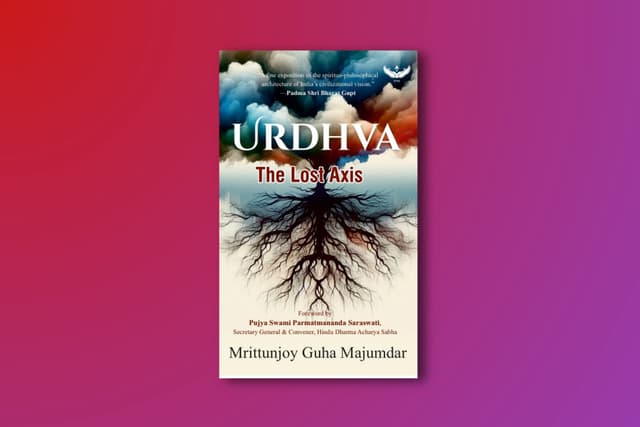
URDHVA: The Lost Axis. Mrittunjoy Guha Majumdar. Garuda Publications. Pages: 280. Price: 489.
The intellectual terrain of 2025 marks the dawn of the Indic Renaissance, a deliberate reclamation and recontextualisation of Darshanic worldviews from Indian traditions. Amid this resurgence, Dr Mrittunjoy Guha Majumdar's Urdhva: The Lost Axis stands not as mere contribution, but as ontological rupture.
A quantum physicist trained at Cambridge's Cavendish Laboratory under Nobel laureate Prof Brian Josephson, Guha Majumdar fuses empirical rigour with Vedic transcendence, bridging physics and Rishi inquiry.
Prologue: The Inverted Cosmology
The book's central argument rests on a single, radical image: the Urdhvamūlavṛkṣa, the 'tree with roots above'. Drawn from the Bhagavad Gita and the Kathopanishad, this inverted tree serves as the governing metaphor for everything that follows. Guha Majumdar argues that the universe and civilisation should be viewed through this inversion, observing that 'all creation is sustained by an invisible current of consciousness. And that civilisations, like trees, flourish only when their roots drink deeply from that infinite source.' (p.ix)
The implications are profound. If consciousness is understood as the foundational ground rather than the final attainment, then evolution ceases to be a linear ascent from matter to spirit. The Western imagination often conceives of evolution as a gradual climb, from stone to plant, from animal to human, and ultimately from human to god. In contrast, Bharatiya thought envisions no such ladder. Consciousness is not the distant summit of becoming but the abiding source, the unchanging reality from which all forms of existence emerge and to which they continually return (p.xi).
The author locates the roots of this inverted cosmology in the avyakta, the unmanifest. Invoking the Chandogya Upanishad, he recalls the dialogue between the sage Uddalaka and his son Śvetaketu, Tat tvam asi ('Thou art That'), a teaching that reveals the unseen sap of consciousness permeating every branch of being, sustaining individuality even as it unites all within a single essence.
This inversion is not merely philosophical abstraction. It is the lens through which Guha Majumdar will examine civilisation, culture, governance, and contemporary application. The rest of the book asks: what happens when we view all of human organisation, from personal development to statecraft, as branches descending from consciousness rather than structures ascending toward it?
Bharatagni: The Civilisational Branch
With the cosmological frame established, the book turns to its first application: understanding Bharat itself as a branch of this inverted tree, sustained by consciousness.
The chapter 'Bharatagni' defines Bharat as more than a nation-state but rather as a 'civilisation, a cultural superorganism, a Dharmic ecosystem' (p.19). As Bharatagni it is 'a living consciousness of tapas, of transformative inner fire, that sustains the dharmic cycle of life, duty, and liberation' (p.22).
In his etymological exploration, the author traces 'Bharata' to the Sanskrit root 'bhr-', meaning 'to bear or carry', and Bharat is the carrier of Agni. The author makes this Agni of Bharat a civilisational core:
From Ashoka’s compassionate edicts to Aryabhata’s cosmic equations, fire has shaped its flux and fervor. Unity thrived in multiplicity, diversity became resonance, and beneath it all, Bharatagni burned—the imperishable flame animating civilization’s endless renewal.(p.25)
This fire, Guha Majumdar argues, is not metaphorical. It is the transformative consciousness that permeates all levels of organisation in India, from the organism's nurturing to social functioning to the liberation of the individual. The fire of the Yajna becomes the visible expression of the invisible root-consciousness feeding Bharat's civilisational tree.
A Republic of Ideas: Consciousness as Intellectual Commons
If Bharatagni describes the civilisational branch sustained by consciousness, the next chapter examines how that consciousness manifested as India's intellectual tradition. The inverted tree metaphor continues: ideas do not emerge from material conditions alone but descend from the same root-consciousness.
'A Republic of Ideas' explores the Vedic intellectual commons as a 'symphony of cosmic notes' (p.35). The author highlights the Nasadiya Sukta of the Rig Veda as a seminal moment in human thought, one that embraced mystery over certainty whilst questioning the origins of existence. This willingness to sit with unknowing, Guha Majumdar suggests, flows directly from a consciousness-first worldview.
Drawing on his background as a physicist, the author finds parallels between ancient Indian philosophies and modern cognitive science. He points to the Drg-Drsya-Viveka as offering a sophisticated model of consciousness that distinguishes between five sheaths of awareness, anticipating modern layered understandings by millennia. He writes:
The philosophical paradigm of jnana (knowledge) in Bharat is inseparable from anubhava (direct experience). This stands in contrast to Cartesian dualism that has dominated Western thought.(p.37)
This principle, reinforced by the 12th-century Kashmiri philosopher Abhinavagupta's description of yoga as Svasamvedana ('self-awareness becoming aware of itself'), shows consciousness turning back upon itself in inquiry. The author argues that Bharat's artistic traditions are not mere artefacts but technologies of consciousness. The concept of Rasa (aesthetic essence) and the Dhvani theory of suggestion in language (Anandavardhana, 9th century) offer sophisticated cognitive models embedded in aesthetic theory.
Crucially, this consciousness did not remain confined to philosophy. It permeated ethics and action. The Bishnoi tradition of Rajasthan exemplifies this: in 1730, Amrita Devi and 363 others sacrificed their lives to protect trees, embodying the idea that 'If a tree is saved even at the cost of one's head, it's worth it.' Consciousness in Bharat, the author shows, moves from metaphysical root to lived ethical branch:
The modern articulation of Sarvodaya (welfare of all) by Mahatma Gandhi drew from the Upanishadic concept of Sarvabhutahite ratah (engaged in the welfare of all beings), demonstrating how these ancient consciousness frameworks remain relevant to contemporary social challenges.(p.40)
The author also explores how consciousness shaped India's sacred geography. The concept of tirthas as focal points for pilgrimage shows physical geography made inseparable from metaphysical significance, what Diana Eck calls a 'mandalised landscape' (p.43). The Ganga serves as both a physical body of water with bacteriophage properties and a celestial descent through Shiva's locks. In Varanasi, Northern Black Polished Ware dating to 800 BCE has been found alongside ritual objects identical to those used today, demonstrating an unbroken ritual continuity sustained by consciousness.
The Meta-Civilisation: Pattern Recognition as Consciousness
Having shown how consciousness shaped Bharat's civilisation and intellectual traditions, Guha Majumdar now examines a more technical dimension: how consciousness manifests as algorithmic thinking. This chapter, 'The Meta-Civilisation', remains grounded in the inverted tree metaphor. Algorithms, the author suggests, are not mechanical constructs but patterns descending from consciousness itself.
The chapter analyses the algorithmic reasoning of ancient Bharat, arguing that the recognition of patterns independent of specific instances was a universal mode of cognition that achieved extraordinary refinement in the Indian tradition (p.75).
The concept of zero (śūnya) exemplifies this. Described as arising from 'fertile ground for conceiving absence as potentiality rather than negation', zero reveals the symmetry between śūnya and ananta (infinity) in Bharatiya mathematical thought. Whilst other civilisations used placeholders for emptiness, it was in Bharat that zero became a number capable of arithmetic operations, operationalised fully by Brahmagupta's Brahmasphutasiddhanta (628 CE). This mathematical innovation, Guha Majumdar argues, flows from the same consciousness-first worldview: emptiness is not void but potentiality, just as the unmanifest (avyakta) is the source from which all manifestation emerges.
A second-order insight connects this directly back to the book's central argument. Dharma itself, Guha Majumdar contends, functions as a 'living algorithm' or 'self-correcting, adaptive code' (pp.82-83). Like a complex programme running multiple variables, Dharma dynamically optimises ethical responses for unique conditions, a concept the author links to desa-kāla-patra, place, time, and circumstance (p.83).
Crucially, this is not mechanical. Dharma as algorithm remains united with the original imagery of the inverted tree (p.84). It is a deep process, consciousness manifesting as adaptive pattern, roots feeding branches that respond to changing conditions whilst remaining connected to the unchanging source.
Vision 6/6: Six Windows into the Same Root
If Dharma is a living algorithm descending from consciousness, how do we apprehend that consciousness? The chapter 'Vision 6/6' addresses this question through the six Darshanas, each offering a different view of the same root-consciousness.
Guha Majumdar argues that in a world obsessed with singular truths, the Darshanas, meaning 'to see', offer six complementary windows into reality. The theoretical physicist in the author adds:
Like science using both classical and quantum mechanics for different contexts, the darshanas encourage us to fluidly shift perspectives without demanding rigid conformity.(p.98)
Each Darshana, the author suggests, represents a branch viewing the roots from a different angle. Nyāya offers logic and epistemology. Vaiśeṣika provides atomistic analysis. Sāṃkhya maps consciousness and matter as distinct principles. Yoga offers experiential practice. Mīmāṃsā grounds inquiry in ritual action. Vedānta points to non-dual awareness.
But Guha Majumdar warns that when overapplied, each can distort, Nyāya into hyperrationalism, Vaiśeṣika into reductionism, Vedānta into spiritual bypassing (p.121). Integration, not absolutism, is the key. This 'integrative metapolity' allows for a kaleidoscopic vision of reality urgently relevant for addressing global challenges like climate change:
Consider climate change: Nyaya helps us parse scientific data and cut through political spin. Vaisheshika dissects the chemical processes warming the planet. Samkhya maps the systemic interdependencies that make the crisis so complex. Yoga fosters emotional connection to the Earth, turning abstract concern into embodied care. Mimamsa grounds us in disciplined action, from personal choices to collective movements. Vedanta situates our efforts within a cosmic vision, inspiring service beyond self-interest. Together, these perspectives offer a multidimensional strategy for a problem too vast for any single approach.pp. 120-1
The author might have extended this principle further to include Buddhist Pratītyasamutpāda, which resonates wonderfully with ecological models, and Saptabhangi (or Syadvada), which theoretical biophysicist G.N. Ramachandran, biologist JBS Haldane, and physicist-educationist D.S. Kothari have all emphasised as offering fresh approaches to reality.
The Rivers of Rasa: Aesthetic Consciousness as Civilisational Vitality
Having established multiple windows into consciousness through the Darshanas, Guha Majumdar now examines how consciousness manifests aesthetically. The chapter 'The Rivers of Rasa' argues that aesthetic consciousness is the invisible force determining a civilisation's vitality.
This returns to the inverted tree: rasa is not decoration added to civilisation but the sap flowing from root-consciousness through every branch. Pointing out that Narada calls Sri Krishna the 'king of rasa', the author shows how rasa is not an accessory but the very essence of life.
The chapter presents a revolutionary view of temple architecture as 'three-dimensional consciousness technology' (p.131). Every element, such as the vāstu puruṣa maṇḍala ground plan, was calculated to create optimal conditions for rasa emergence. The towers (gopurams) function as devices for manipulating consciousness through visual rhythm and mathematical proportion.
The author explains with physicist precision how sacred architecture creates 'consciousness fields': '...spatial environments that systematically induce specific states of awareness in those who enter them with proper preparation' (p.133).
But what happens when this connection is severed? A critical section discusses the 'colonisation of aesthetic awareness'. Guha Majumdar argues that the imposition of Cartesian aesthetics, with its mechanistic worldview and separation of mind and matter, fundamentally altered Bharatiya consciousness. The diagnosis is precise:
A temple sculpture installed in a museum is no longer a vehicle for darshan but merely an object of intellectual curiosity. A classical dance performance on a proscenium stage is no longer spiritual practice but cultural display. A traditional craft reduced to mechanical production is no longer a means of consciousness cultivation but merely economic activity.(p.135)
When the branch is cut from the root, aesthetic experience becomes mere entertainment rather than Rasanubhava, the direct tasting of consciousness itself.
From Diagnosis to Prescription: Rebooting Chaitanya OS
The book now shifts from interpretation to prescription. Having diagnosed how consciousness once structured Bharatiya civilisation and how that connection was severed, Guha Majumdar asks: how do we restore it?
The chapter 'Rebooting a Primordial Operating System' begins with the grim prediction that we stand at the 'precipice of civilisational collapse' (p.149), because of the gradual decay of our operating system. Against the modern matrix, built on 'materialism, individualism, historicism, and hyper-rationalism', the author characterises Patanjali's Yoga Sutras as a 'debugging manual for Chaitanya OS' (p.154).
The section 'The OS Architecture' presents a strikingly original schema by recasting Bharatiya metaphysics in computational language, proposing 'Chaitanya OS' as a consciousness-based operating system for society. This returns to the inverted tree: if consciousness is the root, then society's operating system must be designed to draw from that root rather than sever connection to it.
Chaitanya OS comprises four key layers: the Rasa kernel, Mantra drivers, Yantra UI, and Sadhana apps (p.166). With Rasa as kernel, all processes and institutions become oriented towards consciousness.
In practical terms, this means that all social institutions, economic systems, and political structures must be designed to support and enhance authentic rasa rather than suppress or distort it. Education becomes not just information transfer but rasa cultivation. Work becomes not just economic production but rasa expression. Governance becomes not just conflict management but rasa harmonisation.
Thus art returns to its proper function: not entertainment but Rasanubhava. Against this reboot, however, stand five formidable resistances. Woke Reductionism collapses all experience into 'power dynamics, oppression narratives, and identity categories' (p.178).
Techno-Materialism posits that 'technological progress is the ultimate solution to human problems and that consciousness is merely an emergent property of complex information processing' (p.180).
Nihilism deems existence 'fundamentally meaningless, because it denies the inherent value and meaning that consciousness-based civilisation seeks to recognise and cultivate' (p.181). Corporate Consumerism thrives by keeping consciousness dormant to fuel acquisition-driven fulfilment (p.183). Institutional Inertia resists change 'even when current approaches are obviously failing' (p.186).
Each resistance, Guha Majumdar suggests, keeps the branches severed from roots, perpetuating consciousness-denial as civilisational norm.
Dharma Mandala: Consciousness in Geopolitics
Having proposed Chaitanya OS as the framework for rebooting consciousness-based civilisation, the author now applies this to geopolitics. The chapter 'Dharma Mandala' reimagines statecraft through the same inverted tree lens: what does governance look like when rooted in consciousness rather than power alone?
The author defines Dharma Mandala as an 'evolutionary leap, a meta-political construct that transcends the limitations of traditional realpolitik whilst preserving the strategic acumen that made Chanakya's original formulation so enduring' (p.197).
Yet here Guha Majumdar encounters a tension. Whilst a governance model that 'transcends the limitations of traditional realpolitik' resonates with the book's argument, how much does Chanakya's Raja Mandala, with its emphasis on power, alliances, and sometimes deception, truly fit? The author himself seems to recognise this:
The transition from Raja Mandala to Dharma Mandala represents more than a simple updating of ancient concepts; it constitutes a fundamental shift in the metaphysical assumptions underlying political theory.(p.200)
Sri Aurobindo's critique becomes relevant here. Modern Indian nationalists who embrace Chanakya's realpolitik over Vyasa's ethical strategising risk perpetuating 'savage' methods, plunder masked as progress, rather than noble conquests serving civilisation. A dharmic polity, truly rooted in the inverted tree's consciousness, must elevate beyond Chanakya's strategic web, integrating ethical aims to ensure global networks serve civilisation rather than vice versa.
More promising is Guha Majumdar's elevation of democracy beyond mere mechanism. Transcending internet-Dharmic circles that dismiss democracy whilst romanticising stagnant hierarchies, he pinpoints democracy's sacred dimension, a vision resonating with Dr Ambedkar:
Democracy... is not merely a method for aggregating preferences but a sacred practice through which a community seeks to discern its proper role in the cosmic order.(p.201)
This returns democracy to the inverted tree: governance as collective discernment of dharma, branches aligning with root-consciousness rather than severing from it. His visualisation of four circles and operative principles offers important seed-ideas, each capable of becoming a great tree itself.
Kshatra 2.0: Warrior-Consciousness for Modern Crises
If Dharma Mandala applies consciousness to geopolitics, 'Kshatra 2.0' applies it to power itself. The chapter reimagines Kshatra, the Vedic term for righteous power, as a synthesis of Shakti and Chaitanya for modern crises.
Unlike secular power models that sever action from consciousness, Kshatra 2.0 demands Yogic Kshatra (p.224): leaders integrating warrior effectiveness with sage wisdom through meditation, titiksha (endurance), and sakshi bhava (witness consciousness).
Archetypes like Sri Ram (duty), Sri Krishna (transcendent strategy), and Arjuna (crisis resolution) model this integration. These are not historical figures alone but branches showing how root-consciousness manifests as righteous power. The author urges transformation of military, police, and civic institutions via contemplative training for egoless action, fostering mindful leadership amid global challenges like climate change and inequality.
The inverted tree metaphor persists: power rooted in consciousness serves dharma; power severed from consciousness serves only itself.
The Metapolity of Dharma: Individual and Cosmic Alignment
The final chapter, 'The Metapolity of Dharma', brings the argument full circle. Having traced consciousness from cosmological root through civilisational branches to contemporary application, Guha Majumdar now shows how individual alignment with dharma fuels collective harmony.
Dharma manifests through personal (svadharma), societal (varna-ashrama as merit-based), and rajya (governance) dimensions, transcending rigid hierarchies for fluid alignment with universal rhythm. Raja Dharma elevates rulers as Dharma's protectors, prioritising nyaya (justice), holistic welfare, and self-correction over power.
Dharma integrates cosmic pulsation (srishti-sthiti-samhara) with human flourishing via purusharthas, emphasising lokasamgraha (world welfare). Historical distortions like rigid jati are critiqued, advocating meritocracy, selfless service, and self-awareness for evolutionary ascent toward Urdhva.
This is the inverted tree realised: individual branches aligning with root-consciousness, not through hierarchy imposed from above but through each finding its proper place in the cosmic order. Where individual alignment occurs, collective harmony follows. Where branches drink from roots, civilisation flourishes.
Scattering Seed-Ideas
Urdhva: The Lost Axis embodies its titular tree, an inverted Ashwattha with roots in infinite Chaitanya, branches cascading into civilisational renewal. More crucially, this Skyweave banyan scatters innumerable seed-ideas, each like the Upanishadic banyan seed Uddalaka revealed to Svetaketu: minuscule yet encoding grand trees of nation-building.
Chaitanya OS, Dharma Mandala, Kshatra 2.0, each germinal concept unfolds possibilities for conscious governance, rasa-driven culture, yogic leadership, and dharmic economics. These seeds promise not mere restoration but evolutionary ascent: polities pulsing with cosmic rhythm, economies serving human flourishing, humanity re-rooted in transcendence for a harmonious future.
The young author has placed himself unquestionably in the same branch of the tree where on ascent one finds the likes of Ananda Coomaraswamy, Dharampal and Swami Ranganathananda. It stands shoulder-to-shoulder with their works.
Amazon link to buy: Here
Publisher link to buy: Here
 Join our